
You are familiar with the following scenario for sure: the mix-track is done, but it sounds kind of shallow. All the instruments are placed directly in front of you but there is no perception of depth. The mix is missing clarity. There is a reason for this. In the real world sounds reach our ears from all around and not just from a pair of stereo speakers. Our hearing is very sensitive to the fact that sounds in nature give us a particular sense of space. In the practice of mixing audio we want to and try to artificially create the illusion of a three-dimensional soundscape.
Depth is a front to back space in a mix and Width is the stereo field.
SPATIAL HEARING AND THE SENSE OF DEPTH
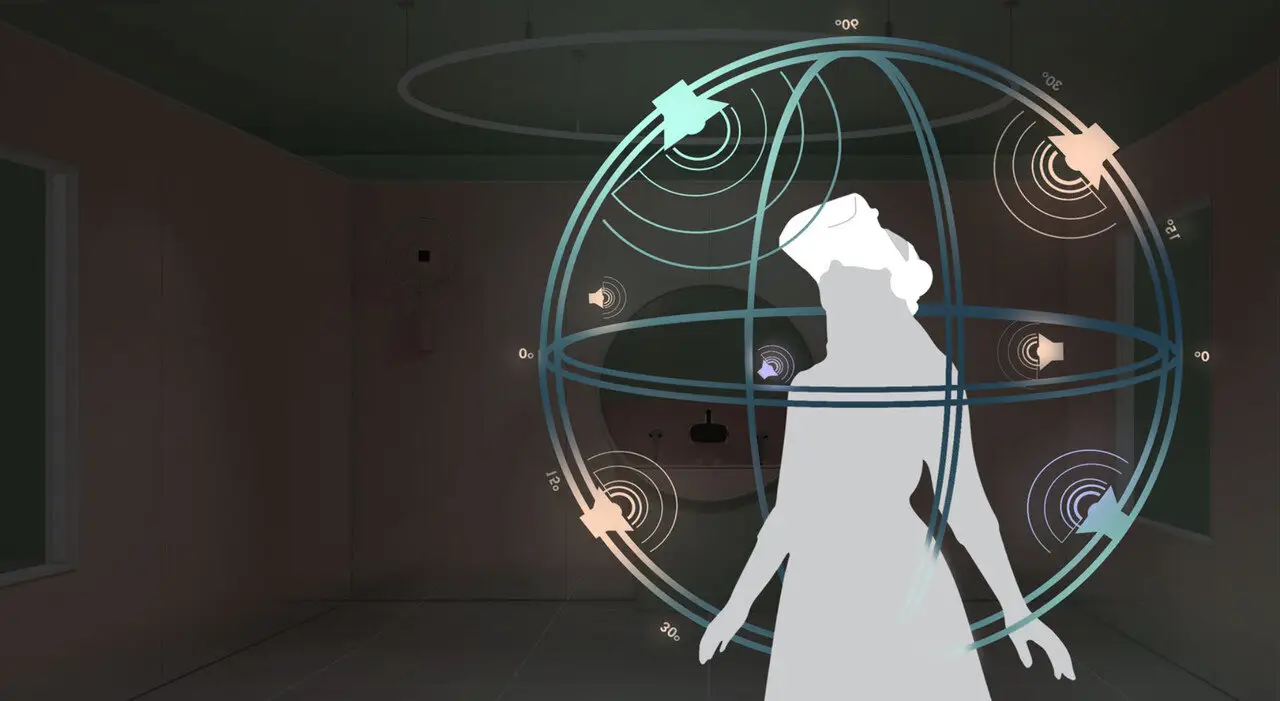
When experiencing spaciousness and depth, the listener receives definitive information about the position of each individual sound source. In nature, the following information helps us to place the source of a sound event:
- Sound Pressure Level (SPL) : Sound decreases in volume over distance.
- Frequency Spectrum: due to dissipation, distance may also change the frequency spectrum of a sound event.
- Directional Information: By means of the Inter-aural level difference ( ILD : the volume difference between the left and the right ear as controlled by the pan-pot) and the inter-aural time difference (ITD: the time difference between each ear) we can tell whether a sound source is coming from the left or the right side.
- Spatial Information: The reflections of a room - split into early reflections and reverberation tells us a lot about the position and proximity of a sound source.
VOLUME
Louder sounds closer. One of the most obvious ways to manipulate depth is with loudness. If we close our eyes in an outdoor space we get a good idea of how near or far people are simply by how loud their footsteps and voices are.
In short, louder sounds appear closer, quieter sounds create a sense of distance. As an approximate guide: to double the distance of a sound, decrease its volume by 6dB.
Mixing with volume is always tricky though because we perceive loudness very differently depending on where the original sound sits in the frequency range. A change in volume at a low frequency can cause very different auditory perception than an equivalent volume change would at a higher frequency.
EQ
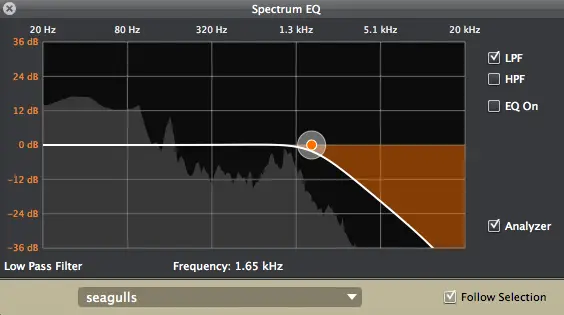
High frequencies are attenuated more strongly by air than are low frequencies. This is due to differences in friction losses (dissipation) over the frequency spectrum.
Lower and mid frequencies therefore travel much longer distances because they are absorbed less by the air.
Because of this, we can make things appear further away by rolling off frequencies in the upper range. To further enhance this illusion, you may want to remove some low-end too. These two moves are commonly used to create a separate space for leads and backgrounds in a vocal mix. Leads will be bright, airy, and upfront (due to a boost around 10–12 kHz) and backgrounds provide the “weight,” sitting below leads in a reduced frequency range.
Furthermore, transients (attack) are typically broadband and have more high frequency components than the corresponding harmonic sound (sustain). Therefore, sounds can be pushed further away by reducing the high frequencies of the attack as well.
REVERB & SPATIAL INFORMATION
In a DAW, reverb is used to simulate the sound of a space, making it a great tool for adding depth to a mix and many a times this tool can go out of hand if abused.
If you have a busy mix, be cautious with the amount of reverb you apply. Cranking up the wet on an instrument is more likely to muddy up a mix than give depth.
The audio reflections that reach our ear about 10-50 ms after the original sound contain most of the information about a room, such as its geometry, size and surface. With an increase in distance from the original sound source inside a given space, the ratio between direct sound and early reflections decreases proportionally. All the later reflections, the reverberation, subtly soften the sound and thereby create a pleasant listening experience.
The delay time of reverb (aka “pre-delay”) allows us to determine the size of a space and is a key parameter for achieving mix depth. Short pre-delay times (0–10 ms) will keep the arrival of the dry signal and reverb close to emulating a small space, whereas longer pre-delay times (20–30 ms) will split the two up, so the reflection and tail arrives at an audible lag, connoting a much larger space.
Think about how sounds behave in large acoustic spaces. The further you are away from them, the quieter they are and the more they’re mixed with the natural reverb of that space. But because high frequencies use up more energy as they move through a space, that energy disappears more quickly too, meaning that sounds are less bright if they have a long way to travel. If you want a Delay or Reverb treatment in your mix to sound ‘deeper’, try rolling off some top end.
WIDTH

If two sounds are exactly the same and play at exactly the same time from each speaker, we perceive it as coming from a center point between the two speakers. This is often called the “phantom mono” or “phantom center.”
The key here is similarity. As soon as the sounds become different, or the timing becomes different, they start to spread across the stereo field.
A prime example is doubled guitars. If you double a guitar part four times and pan two doubles to one side and two doubles to the other, the end result is often not as wide as desired.
The key here is to create as much contrast as possible: use different guitars, amps, and/or mics and mic placement for the doubles. Create contrasting tones. This will allow the ear to hear more separation when they’re panned apart.
Rather than relying on chorusing, haas delays, or doublers, two different takes of a guitar line is going to sound wider than one take sent through a doubler.