Essentially, phase refers to sound waves — or simply put, the vibration of air. When we listen to sound, what we’re hearing are changes in air pressure. Just like the ripple of a stone in water, sound is created by the movement of air. And just as in water, those movements cause a rippling effect — waves comprised of peaks and troughs. Those waves cause our eardrums to vibrate, and our brains translate that information into sound.
Let's start with a sine wave — the simplest audio waveform there is. Every other audio waveform can theoretically be broken down into a collection of sine waves at different frequencies, so by dealing with the concept of phase in terms of sine waves first, we can extrapolate to how they affect the more complicated real-world audio signals you'll find coming out of the back end of a mic.
A sine wave generates only a single audio frequency, according to how many times its waveform shape repeats in a second. For example, a 1kHz sine wave repeats its waveform 1000 times per second, with each waveform repetition lasting 1ms.
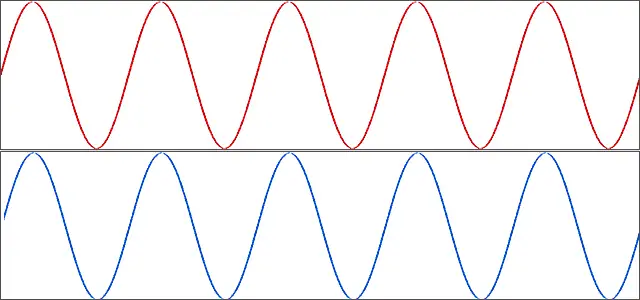
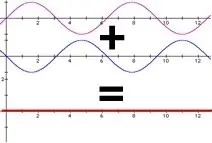
Imagine that you have two mixer channels, each fed from the same sine-wave source at the same frequency. The peaks and troughs of the two waveforms will be exactly in line and mixing them together will simply produce the same sine wave, only louder. In this situation we talk about the two sine waves being 'in phase' with each other.
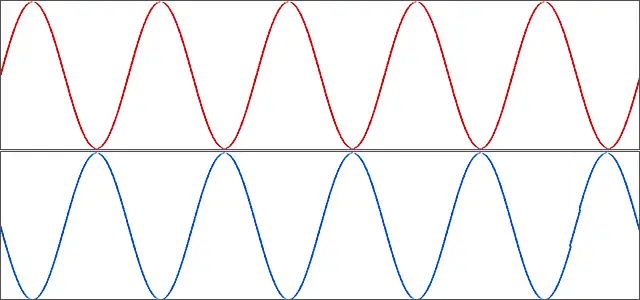
But if one mixer channel with the signal is reversed, as shown in the second illustration, the signals will cancel each other out. In fact, as we are using a pure sine wave, combining both signals out of phase would result in silence, since the sounds would literally cancel each other out.
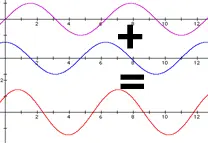
In the real world, we normally don’t listen to pure sine waves. Since most of the music we hear and the instruments we record are a complex combination of multiple waves and harmonics, the results of phase cancellation will be equally complex.
Phasing or Phase Interference
A phenomenon describing the interactions between two or more nearly identical sounds performed simultaneously. It primarily affects amplitude (pressure or power). There are 3 types of phase interference…constructive, destructive, and comb-filtering.
Constructive: occurs due to synchronized phase relationships (0 degrees and 360 degrees). It causes the amplitude to multiply and sometimes resonate.
Destructive – occurs due to phase relationships of 180 degrees. Causes the waves to “cancel each other out”.
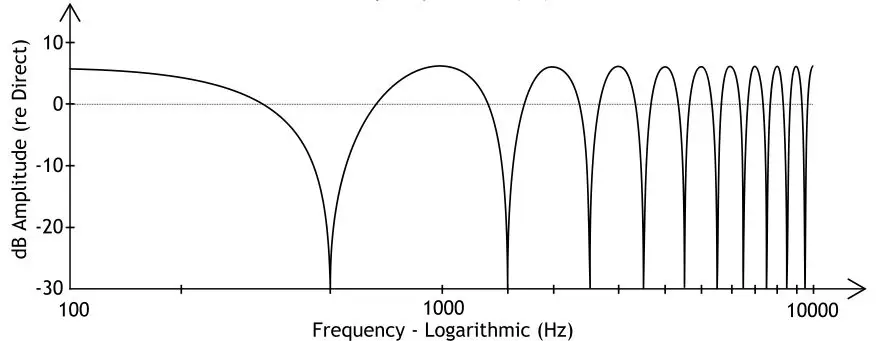
Comb-Filter – causes a series of alternating constructive and destructive “peaks and nulls” due to irregular phase relationships. It accounts for the majority of interference and – because of the peaks and nulls – makes the spectrum appear “comb-like”.
When recording, phase issues can quickly become complicated, usually becoming a problem when more than one channel is used to record a single source, such as stereo miking a guitar, multi-miking a drum set, or using a microphone/DI combo for bass. As sound waves of different frequencies reach different microphones at different times, the potential for one mic to receive a positive phase while another receives a negative is greatly increased, and the relationship between all of these waves’ phases can be unpredictable. In fact, the more mics in play, the more inevitable some sort of phase issues become.
Lets consider a scenario of stereo miking an acoustic guitar. Most often, two mics will be set up, with one pointed toward the sound hole to pick up the lower frequencies, and the second mic pointed toward the neck and fingerboard to pick up the attack. Of course, the guitar’s frequency range covers several octaves, which means a wide range of different audio wavelengths. Since the mics are a fixed distance from the source, those different waves will arrive at the mics at different points.
Inevitably, one or more harmonics will end up sounding weaker than the rest. Your best practice would involve moving the mics very slightly — even a fraction of an inch can make a difference — until you achieve the best sound to your ears.
LISTEN AND TWEAK. THIS IS THE MOST EFFECTIVE METHOD.
If you hear phasing, flip the phase of one input. If you still hear phasing, slightly adjust the position of the mic until you don’t hear it (the phase cancellation) anymore.