
When recording music, mixing tracks, or working with sound, you will often come across two important audio settings: sample rate and bit depth. You may have seen options such as 44.1 kHz, 48 kHz, 16-bit, and 24-bit in your digital audio workstation (DAW) or recording software. But what do these numbers mean? Does a higher sample rate always produce better sound? Is 24-bit audio better than 16-bit? Understanding sample rate vs bit depth helps you choose the right settings for music production, podcasts, film sound, and other recording projects. Although both settings affect how digital audio represents sound, they serve different purposes.
What Is Sample Rate in Digital Audio?
Sample rate refers to the number of times an audio signal is measured every second when converting sound into digital audio. It is measured in Hertz (Hz) or kilohertz (kHz). For example, a sample rate of 44.1 kHz means the system takes 44,100 measurements of the sound signal every second. At 48 kHz, it takes 48,000 measurements per second. Sound travels through the air as continuous changes in pressure. A digital recording system measures these changes at regular intervals and stores them as digital information. These measurements are called samples.
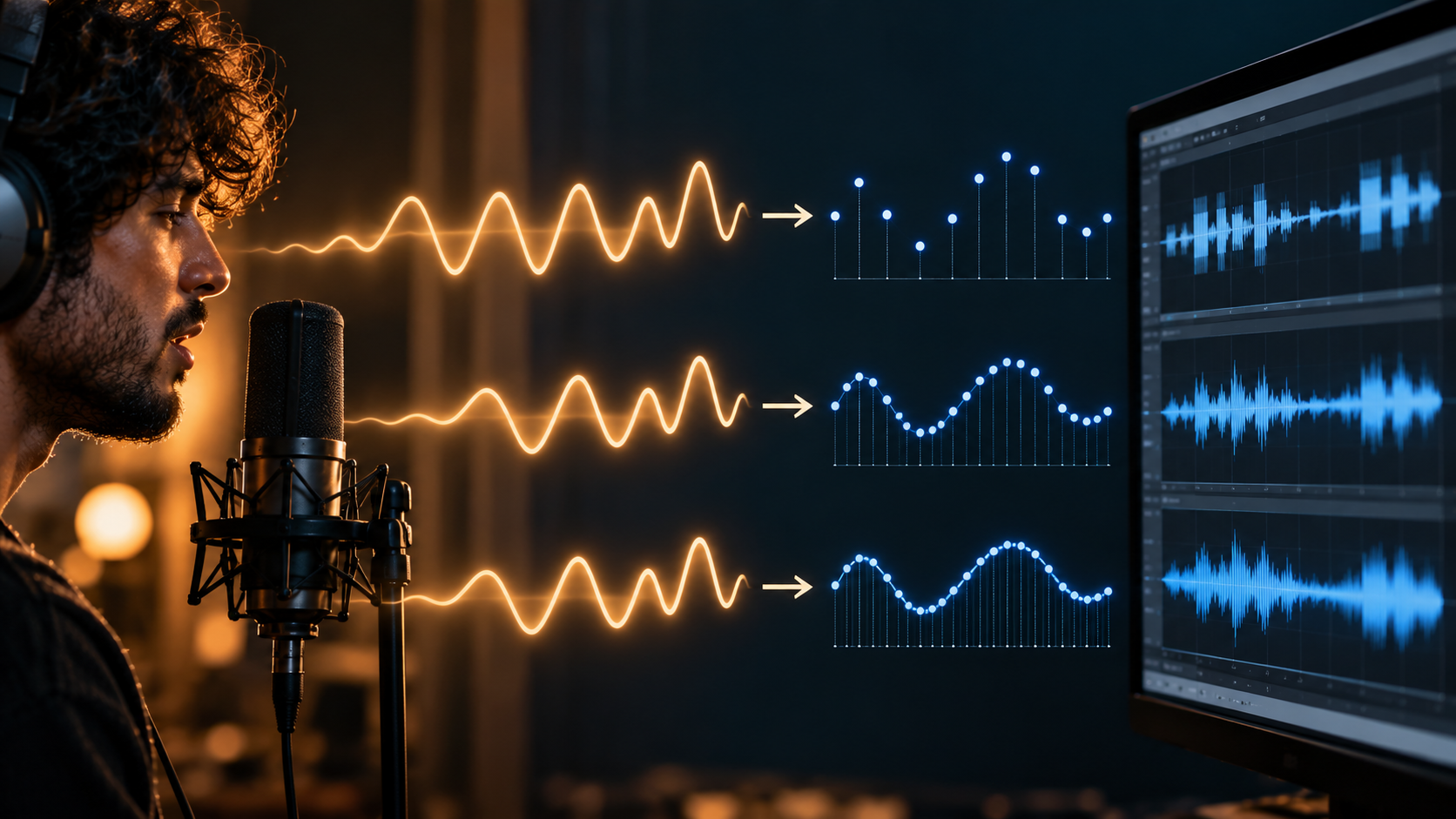
How Does Sample Rate Affect Audio Quality?
Sample rate determines the range of frequencies that a digital audio system can represent. According to the Nyquist-Shannon sampling theorem, the sampling rate must be more than twice the highest frequency being represented, with appropriate filtering.
For example, 44.1 kHz can theoretically represent frequencies up to approximately 22.05 kHz. Since human hearing typically extends to around 20 kHz, this sample rate is sufficient for capturing the audible frequency range under suitable conditions. Higher sample rates, such as 96 kHz, can be useful for specialised sound design, pitch manipulation, and certain audio processing tasks. However, a higher sample rate does not automatically make every recording sound better. Microphone quality, room acoustics, performance, and recording technique also influence the final result.
What Are the Common Audio Sample Rates?
Different sample rates are used depending on the recording's purpose.
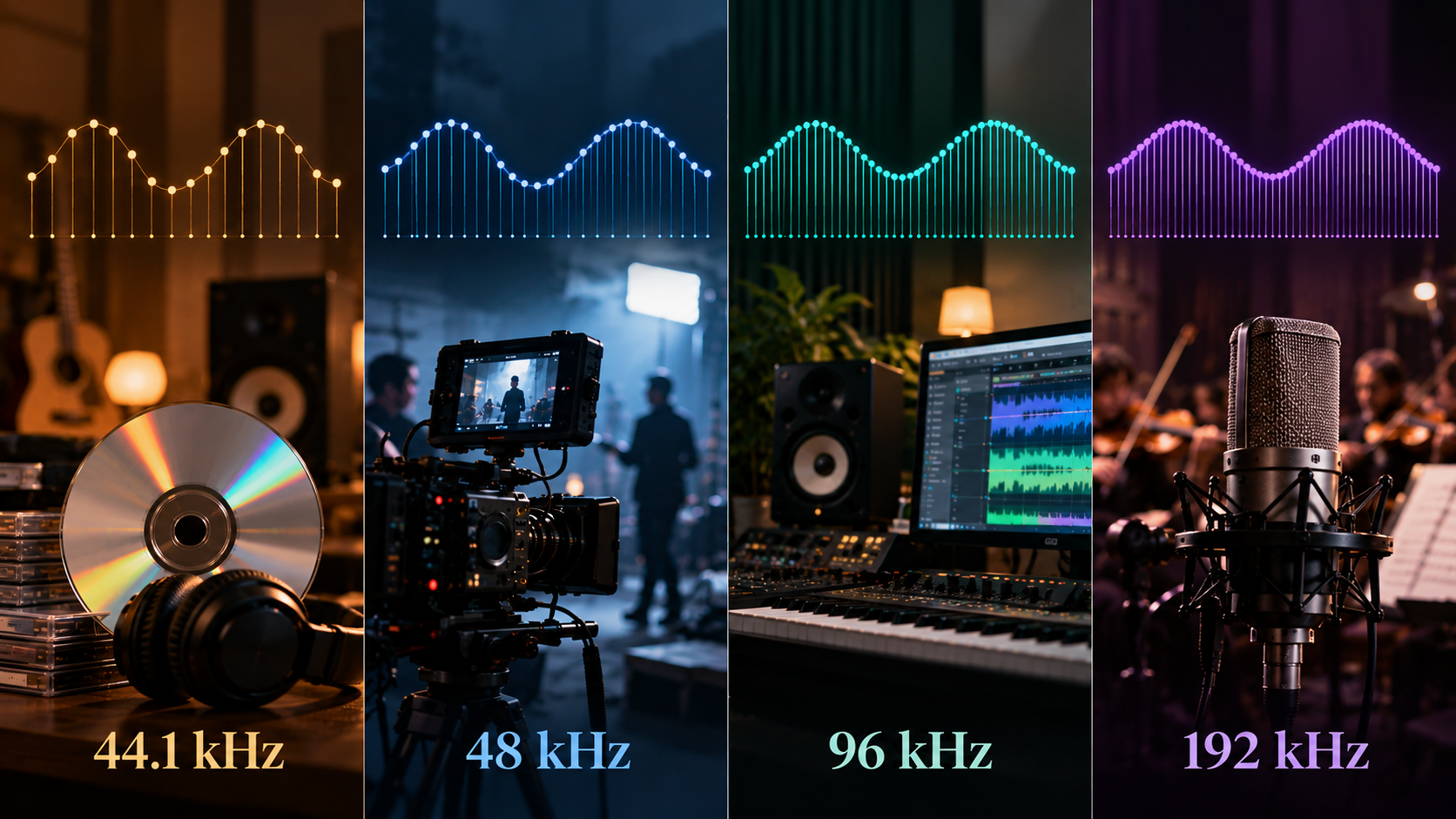
44.1 kHz: Traditionally associated with audio CDs, this sample rate remains common in music production and distribution.
48 kHz: Widely used in film, television, advertisements, and video production, it is a practical choice for audiovisual projects.
96 kHz: Useful for specialised recording and sound design workflows, although it requires more storage space and processing power.
192 kHz: Used in certain specialised applications but unnecessary for most everyday music, podcast, and video projects.
The best sample rate depends on the project's requirements rather than simply choosing the highest available setting.
What Is Bit Depth in Digital Audio?
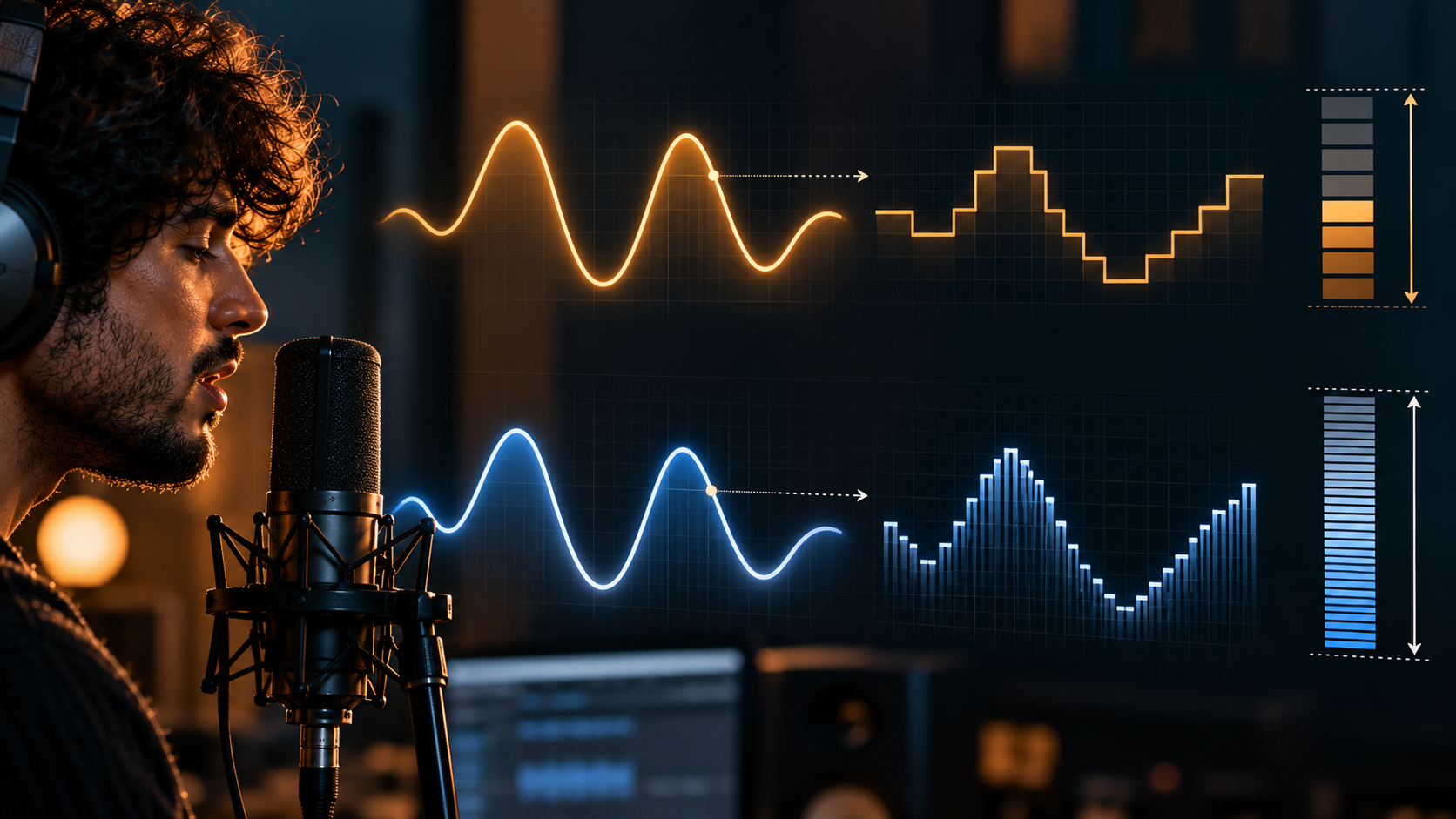
While sample rate determines how frequently sound is measured, bit depth determines how precisely the amplitude of each sample is represented. Amplitude refers to the strength of a sound signal. During digital recording, the system converts each measurement into a numerical value. Bit depth determines how many possible values are available to represent that measurement. A higher bit depth provides more possible amplitude values, allowing greater dynamic range and reducing quantisation noise. Quantisation noise occurs when a measured signal is rounded to one of the available digital values. This is important when recording performances with both loud and quiet sounds. For example, a recording might contain a loud drum hit followed by a soft vocal phrase. Greater bit depth provides more flexibility when capturing these differences without unwanted digital noise becoming a problem.
How Does Bit Depth Affect Audio Quality?
Bit depth primarily affects dynamic range and quantisation noise, not the frequency range of a recording.
16-bit audio provides 65,536 possible amplitude values per sample, with a theoretical dynamic range of approximately 96 dB under ideal conditions.
24-bit audio provides 16,777,216 possible amplitude values per sample, with a theoretical dynamic range of approximately 144 dB under ideal conditions.
For recording, 24-bit audio is generally preferred because it provides greater flexibility when setting input levels. You can leave more headroom to prevent unexpected peaks from clipping while retaining enough precision for quieter passages.
This is particularly useful for recording vocals, live instruments, film dialogue, and location sound. However, the actual dynamic range also depends on the recording equipment, microphone noise, preamplifier performance, and recording environment.
Sample Rate vs Bit Depth: What Is the Difference?
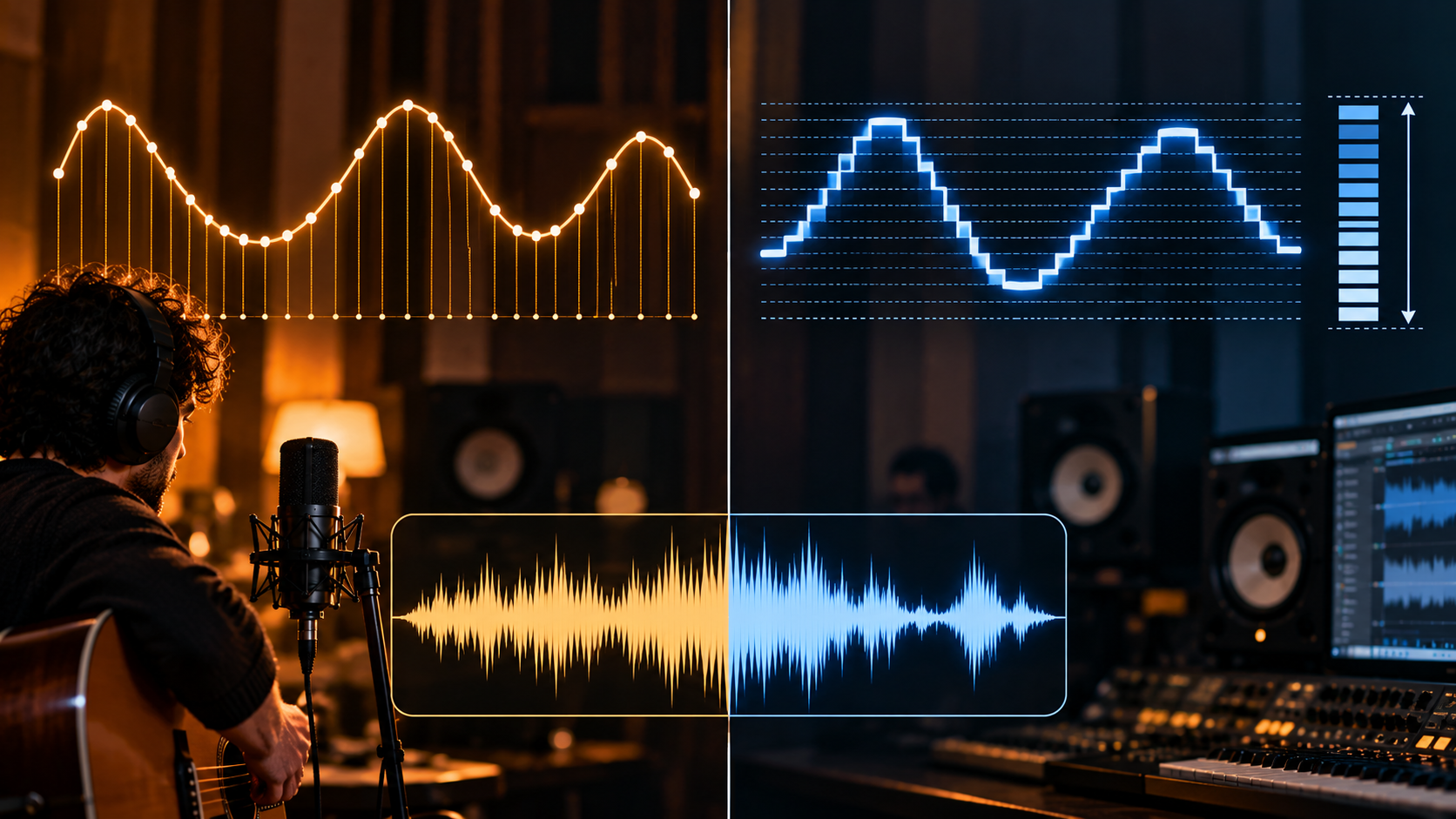
Sample rate and bit depth work together, but they control different aspects of digital audio. Sample rate determines how frequently the audio signal is measured and the highest frequencies that can be represented. Bit depth determines the precision of each amplitude measurement and influences the available dynamic range. Think of recording a musical performance. Sample rate helps determine the range of frequencies captured, while bit depth affects how accurately the signal's level is represented. Increasing the sample rate does not provide the same benefit as increasing bit depth. Similarly, recording at 24-bit does not extend the frequency range in the same way that changing the sample rate can. For most recording projects, 48 kHz at 24-bit is a sensible starting point, particularly for film, video, and general production work.
44.1 kHz vs 48 kHz: Which Should You Choose?
The choice between 44.1 kHz and 48 kHz largely depends on the intended use of your audio. For music-only projects, 44.1 kHz can be a suitable choice. It is widely associated with music distribution and remains a practical option for audio-focused workflows.
For films, advertisements, YouTube videos, and documentaries, 48 kHz is generally the more practical choice because it is widely used in video production. The audible difference between properly recorded audio at these two sample rates is usually not significant under ordinary listening conditions. Both can reproduce the audible frequency range when the recording system is designed appropriately. The most important consideration is consistency. Match your project settings to the intended delivery requirements to avoid unnecessary sample-rate conversions.
16-Bit vs 24-Bit: Which Is Better for Recording?
Both formats can produce excellent audio, but 24-bit is generally more suitable for recording and mixing. Imagine recording a singer whose performance starts quietly and becomes much louder during the chorus. With 24-bit recording, you can leave sufficient headroom for unexpected peaks without sacrificing as much precision in quieter sections. A 16-bit file can be suitable for final delivery, particularly for CD audio. Meanwhile, 24-bit is commonly used for professional recording sessions and high-quality masters. If you are converting a high-resolution master to a lower bit depth, appropriate dithering may be required to minimise the audible effects of quantisation.
What Sample Rate and Bit Depth Should You Use?
For most projects, the following settings provide a practical starting point:
- Music production: 44.1 kHz or 48 kHz at 24-bit.
- Film and video: 48 kHz at 24-bit.
- Podcast recording: 48 kHz at 24-bit.
- Location sound recording: 48 kHz at 24-bit.
- Specialised sound design: 96 kHz when the workflow benefits from it.
Always check the client's or platform's delivery specifications before exporting the final audio.
Does Higher Always Mean Better Audio?
Not necessarily. A higher sample rate can benefit specialised processing tasks, but it cannot fix a poorly recorded performance. Similarly, 24-bit audio provides greater recording flexibility but cannot compensate for background noise, unsuitable microphones, or poor microphone placement. Higher sample rates also increase file sizes and processing requirements. The goal is to choose settings that meet your project's needs while maintaining an efficient workflow.
Understanding sample rate vs bit depth is an important step towards becoming a confident sound engineer or music producer.
Sample rate determines how frequently an audio signal is sampled, while bit depth determines the precision of each amplitude measurement. Both contribute to digital audio quality, but they serve different purposes. For most modern recording projects, 48 kHz at 24-bit is a reliable starting point, especially for video, film, podcasts, and general production. Music-only projects may also use 44.1 kHz, depending on the workflow. Ultimately, professional audio is not about choosing the biggest numbers. It is about understanding your equipment, recording carefully, and selecting the right settings for the project. At TAG Mumbai, understanding these audio fundamentals helps aspiring sound engineers and music producers build the technical knowledge needed to record, edit, mix, and produce sound with confidence.